
Global warming is one of the most significant issues in the world. Addressing the challenges posed by climate change has become an international consensus. As a leading company in the dairy industry, sustainable development is our commitment to stakeholders and has also become our core competitive strength in the market. In 2021, Yili committed to achieve carbon neutrality by 2050, becoming the first company in China's food industry to set carbon neutrality target. Yili has been actively working to decrease our greenhouse gas emissions through both technological measures and improved management practices. We have also consistently dedicated ourselves to assisting suppliers in effectively reducing their energy consumption in order to achieve the goal of lowering greenhouse gas emissions. This collaboration not only aids in environmental improvement but also encourages the entire supply chain to evolve towards greater sustainability. We hope that through our efforts, we can provide good examples and references for others.
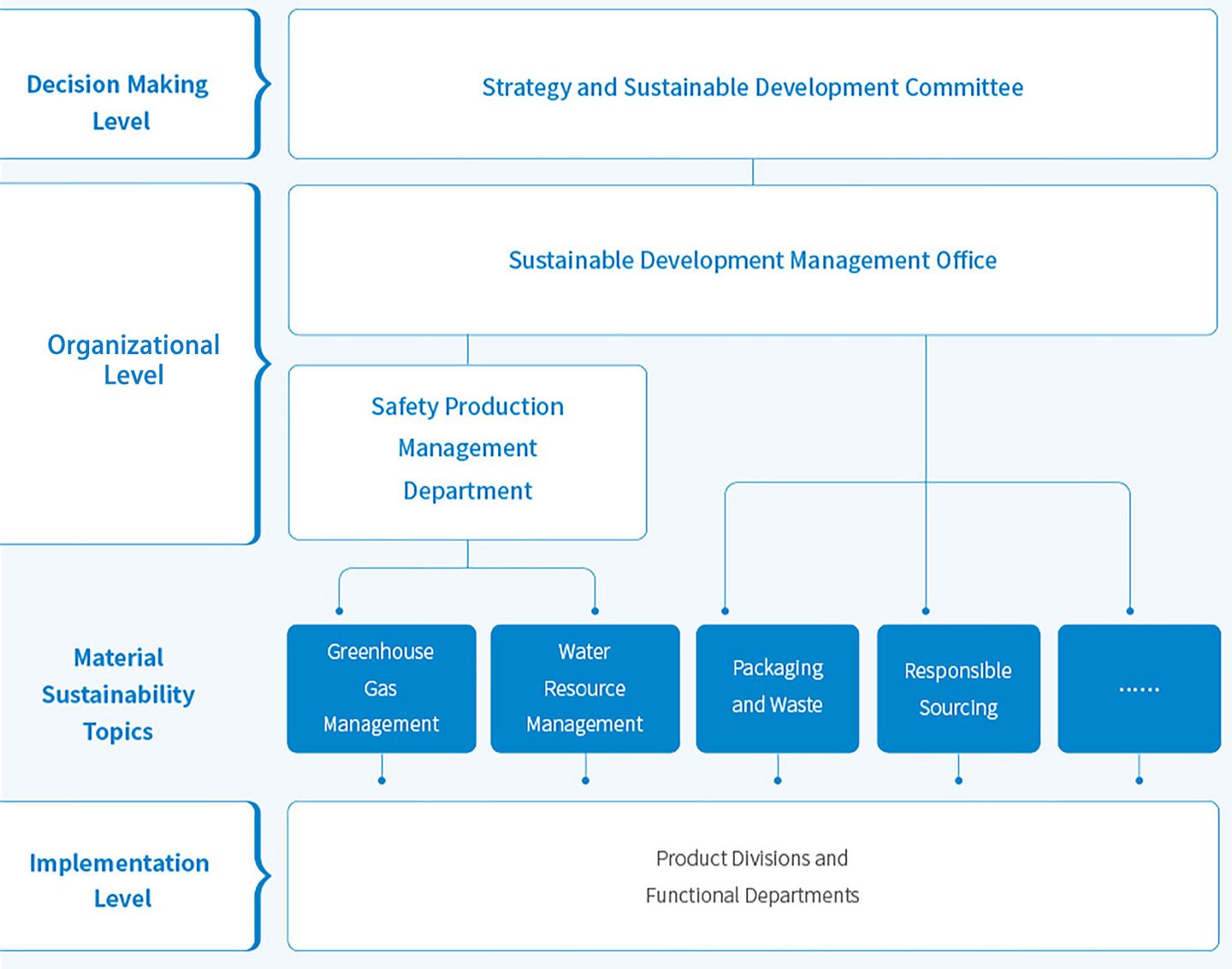
Yili has established a Strategy and Sustainable Development Committee at the board level, which is composed of eight directors (including two independent directors), under the charge of Mr. Pan Gang, the Chairman and President of Yili. Apart from business development strategy, the Committee also focuses on researching and recommending sustainability strategic plans for Yili's long-term development. The Committee also oversees its sustainability strategy implementation across the company (including greenhouse gas management). The Sustainable Development Office is under Strategy and Sustainable Development Committee, which is responsible for the sustainability performance supervision and report to the Strategy and Sustainable Development Committee on a regular basis. The Safety Production Management Department of Yili is responsible for day-to-day management of GHG emissions. The department is equipped with a professional carbon management team to provide technical support for executing the GHG reduction project across Yili's different business units. The quarterly progress reports are submitted to the Sustainable Development Management Office for review and monitoring purposes.
In order to achieve the goal of carbon neutrality by 2050, Yili released its Carbon Neutral Plan in 2022, named "Zero-Carbon Future Plan of Yili Group". This plan provides a strategic carbon reduction roadmap and detailed guidance for carbon reduction.
Structuring Yili's high-quality development plans.
Refining Yili's development strategy and principles
Considering carbon peak and carbon neutrality into Yili's business development
Announcing carbon peak achievement in 2012
Achieving carbon neutral by 2050
2012
The base line year for setting up Yili's emission reduction targets

2021
A preliminary green, low-carbon and circular development business model is formed, with energy efficiency greatly improved

2030
Achieve significant progress in "green" transition across the entire supply chain, bringing operation energy consumption efficiency to world's leading level

2040
Achieve high level of low-carbon and circular development; the energy consumption efficiency of our entire supply chain meet the highest international standards

2050
Carbon neutrality throughout the whole supply

In addition to achieving the ultimate goal of "carbon neutrality" by 2050, our "Zero-Carbon Future Plan of Yili Group" also establishes several milestone targets. Some targets and their progress made in 2025 are as follows:
| Target Categories | Target Value | Progress made in 2025 | Target Progress |
|---|---|---|---|
| Operational Carbon Reduction | By 2030, the carbon emission of Scope 1 and 2 will be reduced by 35% compared with 2012. | Reduced by 39% | Achieved |
| By 2030, the carbon intensity per ton of product will be reduced by 65% compared with 2012. | Reduced by 65% | Achieved | |
| Coverage of measuring Scope 3 carbon emissions | By 2025, the carbon footprint verification for all core raw milk suppliers? will be completed. | 100% completed | Achieved |
| By 2030, the carbon footprint verification for all core suppliers of raw and auxiliary material will be completed. | 70.88% completed | In progress | |
| Targets on supply chain carbon emissions reduction | By 2030, the carbon intensity of core raw milk suppliers will be reduced by 35% compared with 2021. | Reduced by 33.15% | In progress |
| The carbon intensity of low-carbon transition suppliers? will be reduced by 7% by 2030, with 2021 as the base year. | Reduced by 7.28% | Achieved |
*? Core raw milk suppliers: it refers to suppliers demonstrating excellence in price competitiveness, quality assurance, delivery reliability, technical support, service responsiveness, asset management, process optimization, and workforce management, including dairy farms that Yili holds 100%, majority or partial ownership. *? Low-carbon transition suppliers: it refers to suppliers committed to carbon inventory, implementing emissions reduction initiatives, and advancing toward carbon neutrality through operational transformations.
Yili has assessed the GHG emissions for the life cycle of all 8 core category products in accordance with the ISO 14067:2018 standard. The assessments cover the planting, breeding, transport, production, and disposal stages of the products.
Carbon emissions from production of Tier 1 raw and auxiliary materials?
Carbon emissions from production of Tier 2 raw and auxiliary materials?
Carbon emissions from production of products
Carbon emissions from transportation
Carbon emissions from product storage
Carbon emissions from waste disposal
Carbon emissions from production of Tier 1 raw and auxiliary materials
Carbon emissions from production of Tier 2 raw and auxiliary materials
Carbon emissions from production of products
Carbon emissions from transportation
Carbon emissions from product storage
Carbon emissions from waste disposal
Carbon emissions from production of Tier 1 raw and auxiliary materials
Carbon emissions from production of Tier 2 raw and auxiliary materials
Carbon emissions from production of products
Carbon emissions from transportation
Carbon emissions from product storage
Carbon emissions from waste disposal
Carbon emissions from production of Tier 1 raw and auxiliary materials
Carbon emissions from production of Tier 2 raw and auxiliary materials
Carbon emissions from production of products
Carbon emissions from transportation
Carbon emissions from product storage
Carbon emissions from waste disposal
Carbon emissions from production of Tier 1 raw and auxiliary materials
Carbon emissions from production of Tier 2 raw and auxiliary materials
Carbon emissions from production of products
Carbon emissions from transportation
Carbon emissions from product storage
Carbon emissions from waste disposal
Carbon emissions from production of Tier 1 raw and auxiliary materials
Carbon emissions from production of Tier 2 raw and auxiliary materials
Carbon emissions from production of products
Carbon emissions from transportation
Carbon emissions from product storage
Carbon emissions from waste disposal
Carbon emissions from production of Tier 1 raw and auxiliary materials
Carbon emissions from production of Tier 2 raw and auxiliary materials
Carbon emissions from production of products
Carbon emissions from transportation
Carbon emissions from product storage
Carbon emissions from waste disposal
Carbon emissions from production of Tier 1 raw and auxiliary materials
Carbon emissions from production of Tier 2 raw and auxiliary materials
Carbon emissions from production of products
Carbon emissions from transportation
Carbon emissions from product storage
Carbon emissions from waste disposal
Carbon emissions from raw materials acquisition and transportation
Carbon emissions from production of products
Carbon emissions from transportation
Carbon emissions from waste disposal
*? Tier 1 raw and auxiliary materials suppliers: the direct suppliers *? Tier 2 raw and auxiliary materials suppliers: the indirect suppliers

Step up energy efficiency retrofits
The demonstrative milk production plant is located in the heart of Yili Modern Intelligent Health Valley. The aim of the plant is to establish a global manufacturing benchmark in terms of scale, automation, technology, and carbon emissions. The project applies the most advanced technology in thermal energy recycling in aspects such as architectural design, energy circulation, production processes, and logistics storage. It can save 5,329 tons of standard coal annually and reduce carbon emissions by 41,895 tons. The daily energy savings are equivalent to the daily electricity usage of 930 households.
The wastewater treatment plant at the Weifang Yili Dairy Factory has an annual carbon emission of approximately 4,200 tonnes. In 2022, the factory achieved 'carbon neutrality' through various pollution and carbon reduction initiatives including biogas recycling, air blower replacement, sludge minimization, methane utilization, and distributed solar power generation, etc. These upgrades reduced approximately 4,284 tonnes of carbon emissions and saved RMB 640,000 in electricity costs and RMB 1,160,000 in steam costs, respectively.

Clean energy utilization
In March 2023, Longyou Yili Dairy Factory successfully connected its 5.77 MW distributed photovoltaic power station to the grid.It is the largest distributed photovoltaic installation in China's dairy industry. The project includes an energy management platform, has integrated 20 energy management sub-systems, and has 554 monitored indicotors. Annually, the project reduces energy costs by more than 2 million RMB and reduced carbon emissions by 3,050 tons of CO?e.
Yili Yunnan Factory obtained a 'Green Electricity Certificate' in 2021, issued by the Kunming Power Exchange Center, for purchasing renewable energy from Yunnan Province. It is the first such certificate in China's dairy industry. In 2022, by purchasing renewable energy and China Certified Emission Reductions (CCER) credits, the Yili Yunnan Factory became the first Yili factory to achieve carbon neutrality.

Supply chain carbon reduction
Youran Dairy is a core raw milk supplier for Yili. In 2025, Yili continues its partnership with core raw milk suppliers in its emission reduction project. The Houshandai Dairy Farm under Youran Dairy generated biogas through thermophilic fermentation of manure after solid-liquid separation, producing up to 6.25 million cubic meters of biogas annually for a single 10,000-head dairy farm, When this amount is fully used for power generation, it will produce approximately 11.5 million kWh of electricity per year. By the end of 2025, anaerobic fermentation biogas power generation projects had been established and operated at 18 dairy farms under Youran Dairy. In 2025, the Zhumadian Dairy Farm adopted the "mesophilic and thermophilic anaerobic fermentation process", which significantly increased biogas production efficiency. This biogas utilization project passed the official technical review under Verified Carbon Standard (VCS) and successfully obtained 91,300 tons of carbon credits, the highest carbon credit ever received by a Chinese dairy farm.
In 2025, Yili continued to collaborate with suppliers on carbon reduction initiatives. Regarding the use of packaging materials, Yili worked with suppliers to promote the replacement of traditional cardboard boxes with reusable containers, using 74,000 fewer cardboard boxes and reducing annual carbon emissions by 25.16 tons. Simultaneously, Yili worked with suppliers to reduce packaging weight and use less plastic. By decreasing the use of PE pellets in yogurt bottles, it reduced pellet consumption of the year by 136 tons, leading to approximately 394 tons of carbon emissions reduction. Through close collaboration with its suppliers, Yili provided replicable experience for carbon reduction across the industrial chain, contributing to the green development of the industry.
Our People & Community
>Our Business
>